
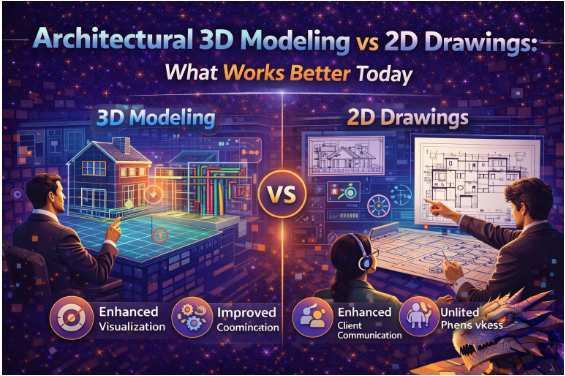

Architecture has always been a profession in which drawing is an integral component of the transfer of ideas, intentions, and details. For the longest time, the architectural way of drawing was the 2D drawing of the plan, section, or elevation.
However, due to the increased complexity of projects as well as the changing nature of the client’s expectations, architectural 3D modeling has slowly become an alternative representation process in the industry.
Therefore, where are we today? Is it truly a matter of 2D drawings versus 3D modeling? Rather, it boils down to recognizing that today’s methods are best suited for clarity, coordination, and decision-making—and that 3D modeling stands head and shoulders above in all three of those areas.
The Strengths and Weaknesses of 2D Drawings
2D drawings have continued to be useful in architecture. They are accurate, standard, and an essential part of documentation and erection processes. Contractors still use them for measurement and detail.
But a 2-D sketch has several limitations:
- They demand technical know-how in interpretation
- The relationships in space are not immediately apparent
- Several drawings have to be correlated
- Design intent can be misinterpreted by non-technical stakeholders
When it came to clients, developers, and consultants, an image of the building based on two-dimensional designs always had some degree of uncertainty.
It is this gap that creates difficulties.
How 3D Modeling Revolutionizes Design Understanding
Three-Dimensional Architectural Modeling allows drawings to be translated into fully navigable virtual models. Rather than trying to visualize how spaces are related to one another, all stakeholders can view it firsthand.
With 3D models, the following things are immediately understood:
- Scale and proportions
- Lighting and Materials Influence
Such clarity ensures that there are fewer instances of misinterpretation. All parties concerned, architects and engineers as well as clients, are looking at the same model for understanding.
Communication: The Biggest Differentiator
Communication: It’s here that the superiority of 3D Modeling over the use of 2D drawings becomes most evident.
Though the technical audience gets spoken to by the 2D drawings, the 3D model can be universally understood. One does not require any explanation regarding the symbols in the 2D drawings.
Such enhanced communication results in:
- Faster approvals
- More meaningful feedback
- Less misunderstandings
- Increased client confidence
In the current client-centric culture, this benefit is important.
Accuracy of Design and Conflict Resolution
Design conflicts can be obscured in 2D drawings. Structural members, services, and architecture can be correct on their own but incorrect when placed together.
All the elements are introduced into a single environment by 3-D modeling. Conflicts such as:
- Some structural elements intersecting spaces
- MEP Systems With Reduced Ceiling Heights
- Openings Out of Alignment with Interiors
Early visibility enhances accuracy and avoids costly changes in construction.
Decision-Making in Modern Projects
Today, the process of making architectural choices can be described by the words fast-paced and dynamic. The use of 2D images alone leads to slower decision-making, since a greater cognitive process is required for interpretation.
3D models enable faster, more assured decision-making by facilitating the following:
- Visualization of comparison designs
- Assess the material and layout in context
- Have understanding before committing
This allows 3D modeling to be even more effective in design review and approval processes as compared to the previous workflow.
Today’s projects entail the involvement of various teams at the same time. Coordination can be an issue when different teams review and understand various 2D drawings.
3D models provide a common thread that enables collaboration. Architects, engineers, and consultants can collaborate on models together, and communication regarding changes is easier.
This is one reason why many companies today find themselves partnering with a professional 3D visualization firm to help out with projects in which there is a lot of coordination required.
2D Drawings Still Matter
Notwithstanding its benefits, 3D modeling does not obviate the need for 2D drawings. Construction documentation, submission of regulatory filings, and technical detailing are increasingly being carried out using 2D outputs.
In practice:
- 3-D Modeling facilitates design understanding and collaboration
- 2D drawings provide precision and conformance
The best workflow will leverage both processes, using each where it excels.
The Modern Architectural Workflow
Today’s most successful companies aren’t deciding between 2D and 3D. They’re doing both.
A modern workflow process might look like this:
- Concepts formulated and validated through 3D
- Design refinement by visual coordination
- Decisions validated using models
- The final documentation done in 2D
Through this method, risks are reduced, communication is effective, and technical details are also correct throughout the whole life cycle of the project.
Client Expectations Have Changed
The most important reason why 3D modeling is more effective today is simply that clients demand and expect this.
Clients want to see what they are investing their money in. Flat designs do not meet current expectations regarding understanding and confidence. Companies that use 3D models for presenting their designs are considered more professional, transparent, and visionary.
Engaging an experienced 3D visualization company can assist architects in addressing these demands without affecting design quality or efficiency of workflow.
Conclusion
Therefore, what is the best approach in the present scenario: using 2D drawing or 3D modeling? The truth is: even as 2D drawing is a fundamental process in the technical implementation of projects, architectural 3D modeling is the prevalent approach in the area of design communication and decision-making.
In such a complex and cooperative industry that works for the benefit of clients, 3D modeling can provide clarity beyond what is achievable through 2D drawing. Together with 2D drawing, there is nothing quite like what can result from their combined use.
In the modern architectural landscape, 3D modeling is not just an upgrade; it is a necessity.